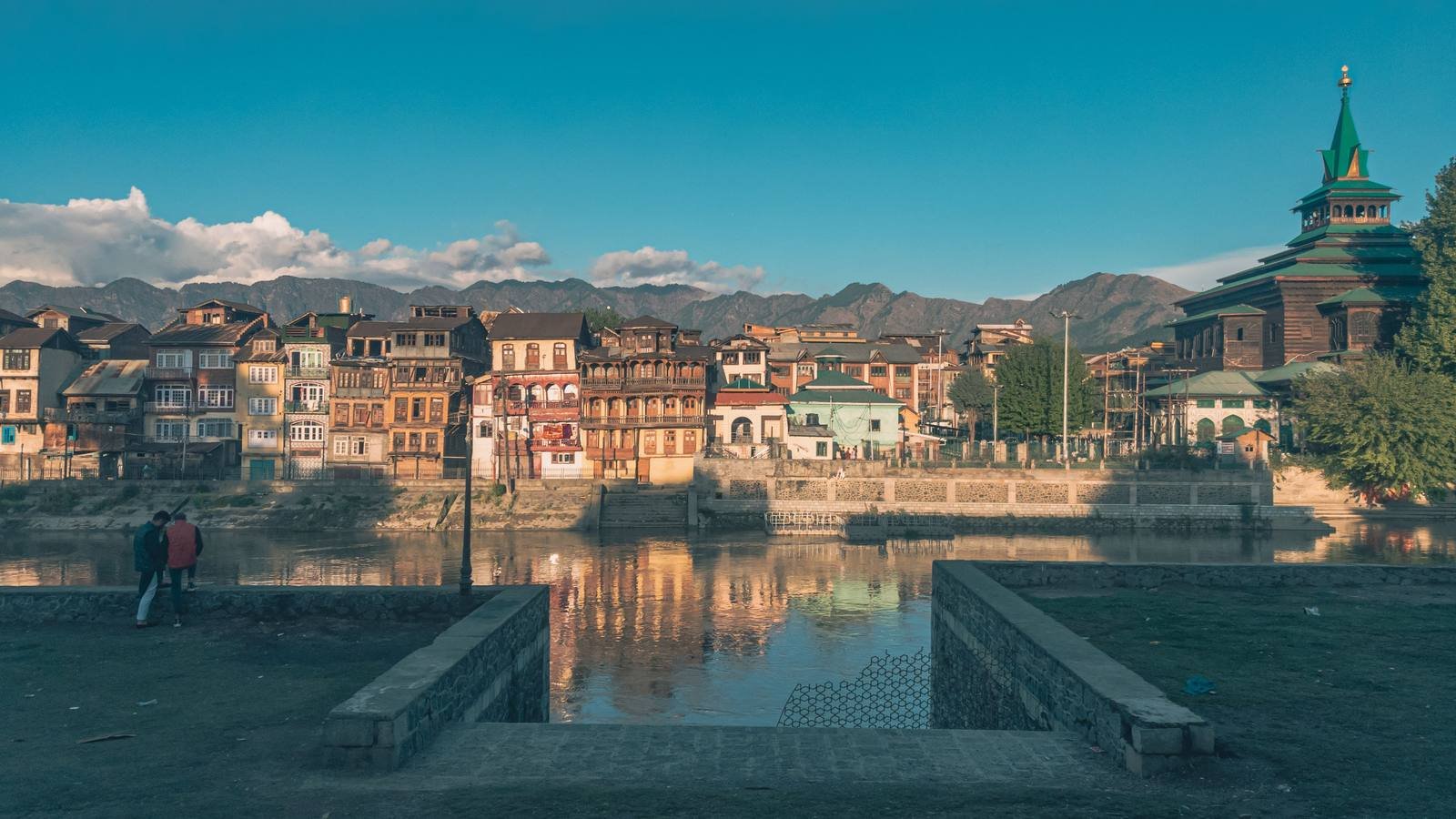
Most families see the Srinagar of the lake and the gardens: Boulevard Road, a shikara, Nishat and Shalimar. The older city along the Jhelum is a different place. Wooden houses lean over the river, lanes narrow to a single car, and some of Kashmir's most important shrines sit a few minutes apart. Our one-day Srinagar plan for families leaves this part of the city for a second day on purpose. This post is that second day, shaped around children.
It is a half day, not a full one. Three stops, a short walk by the river and back to the hotel for a late lunch is plenty for most kids.
The half day in a few lines
- Stop 1: Hazratbal shrine on the northern shore of Dal Lake
- Stop 2: Jama Masjid in Nowhatta, in the heart of the old city
- Stop 3: Khanqah-e-Moula on the bank of the Jhelum, with a short riverside walk
- Getting around: by car between the stops; on foot only for the riverside stretch
- Best days: Saturday to Thursday. Avoid Friday (more on that below)
- What to carry: a scarf for every woman in the group, socks, and shoes that slip off easily
We do not print opening hours here. The Directorate of Tourism, Kashmir describes these shrines as open through the day and asks visitors to come outside prayer times, and prayer times move through the year. Your driver will know when to arrive so you are not walking in as a congregation starts.
Dress, shoes and photos at the shrines
These are working places of worship first and sights second. The Directorate's own visitor pages for Hazratbal, Jama Masjid and Khanqah-e-Moula agree on the basics:
- Dress modestly. Women are expected to cover their heads at all three. The Khanqah-e-Moula page adds that men should avoid shorts. Long sleeves and long trousers or a long kurta keep things simple for everyone, children included. Many families also carry a light scarf for older girls.
- Shoes come off. At Hazratbal before the prayer hall, at Jama Masjid before the courtyard, at Khanqah-e-Moula before you enter. In late October the stone and marble are cold underfoot, so put the children in warm socks.
- Photos outside, ask inside. Photographing the exteriors is generally fine. Inside, ask first. At Hazratbal photography of the holy relic may be restricted, and at Khanqah-e-Moula interior photos need permission. Drones are not allowed at the Khanqah.
- Women and the Khanqah's main hall. The Directorate says women are not allowed inside the main prayer hall at Khanqah-e-Moula. They can visit the exterior, the courtyard and the areas set aside for them. Tell your family before you go, so nobody is surprised at the door.
The Directorate also notes that visitors of all faiths are welcome at Hazratbal. Our Kashmir travel safety guide gives the same dress advice for the old city in general.
With children, one more rule matters more than any of these: no running and no shouting inside, and a hand on the toddler. Brief the kids in the car. A child who knows why the voices drop usually copes well.
Why we keep the old city off Fridays
Friday is the main congregational prayer day. The Department of Tourism's pilgrim brochure says thousands gather at Hazratbal on Fridays and thousands come to Jama Masjid for Friday prayers. The Directorate's Jama Masjid page says plainly to visit outside Friday prayers, when the mosque is extremely crowded.
For a family that means slow traffic around the shrines, nowhere to stop the car and courtyards full of people at prayer. So we plan the old city for any other day.
The same thinking applies to special days. The holy relic at Hazratbal is displayed only on certain religious occasions, about ten a year according to the brochure, and those days draw very large crowds and tighter security. These dates follow the Islamic calendar and shift each year, so tell us your dates and we will check them before we fix the day.
A family morning in the old city
Hazratbal first
Start at Hazratbal while the children are fresh. The white marble dome stands on the northern shore of Dal, with the Zabarwan hills behind it. The Department of Tourism brochure describes a garden lined with chinars around the shrine. Those chinars are one reason to come in autumn, when the leaves turn.
The lakeside gives children room to walk before the old city lanes. Women and girls cover their heads, everyone leaves their shoes and the family can look in quietly. The Directorate lists parking and restrooms at the shrine, which helps with small children and grandparents. We plan under an hour here; that is our own planning time, not an official one.
If you would like to arrive the slow way, the Directorate notes that Hazratbal can be reached by shikara across Dal Lake. It is a longer route than a standard hour on the lake, so mention it when you book. Our shikara ride page explains how rides work from the Boulevard ghats.
Jama Masjid in Nowhatta
From Hazratbal the car takes you into the old city to Jama Masjid, the largest mosque in Kashmir. The Department of Tourism's brochure counts 378 deodar pillars holding up the roof, with a square garden and a central fountain in the courtyard.
Children like a job, and this is an easy one: ask them to count pillars along one side, or find the tallest. It keeps small feet walking slowly and voices low.
Outside, the bazaars around the mosque are busy and the lanes are tight. Keep children's hands held here and let the driver choose where to drop and pick you up. Next door is Khanqah-e-Naqshbandi, a 17th-century wooden shrine, if anyone wants one more look; with young children we usually do not add it.
Khanqah-e-Moula and the Jhelum
The last stop is the one most adults remember. Khanqah-e-Moula, also called the Shah-e-Hamadan mosque, stands on the bank of the Jhelum and is dedicated to the Sufi saint Mir Syed Ali Hamadani. It is built of deodar wood. The Department of Tourism dates the present building to 1732, after a fire destroyed the earlier one, and describes Quranic calligraphy on the ceiling and the carved panelling called khatamband.
The Directorate's own advice is that the shrine is best seen from across the river, to take in the whole building and its riverside setting. That suits children. The view from the far bank, with the green spire, wooden houses and the water, needs no explaining.
A note from our desk: the Directorate's pages give the gap between Jama Masjid and the Khanqah as about 1 km on one page and 2 km on another. With children we do not walk it. We drive and save the walking for the river.
The short heritage walk by the river
This is not a guided tour, just a gentle stretch along the Jhelum near the Khanqah. JKTDC places the shrine on the right bank between the third and fourth of the city's old bridges, which locals call kadals. From the bank you see wooden houses with carved windows, the bridges and the Khanqah's spire over the water.
How we plan it with children:
- Keep it short. Twenty to thirty minutes is enough for most kids. That is our own planning figure.
- Walk one way. The driver meets you at the other end, so nobody has to walk back.
- Mind the traffic. The Directorate warns that the lanes around the shrine are narrow and to be careful of traffic when walking. Small children stay on the inside, holding a hand.
- Stay back from the edge. Do not assume the river edge is fenced along the way. A toddler in a carrier is easier than a pram here.
If the children are flagging, skip the walk and look at the river from the car. The Khanqah is still worth the stop.
Two extras if the morning goes well
Badamwari garden. The Srinagar district page describes Badamwari as a historic garden at the foot of Koh-e-Maran (Hari Parbat), famous for its almond blossom in spring, revived and opened to the public in 2008. In October and November there is no blossom, but it is a green, open place for children to run after a morning of quiet. Check that it is open on your day.
Makhdoom Sahib on Hari Parbat. The Directorate puts the climb at about 500 steps, taking 20 to 30 minutes, and notes that Thursdays are the busiest day. With small children or older parents we leave it out unless the family really wants it. If you are travelling with grandparents, our Kashmir trip with elderly parents post explains how we pace a week like this.
The old city in late October and November
The weather works in your favour for a morning plan. IMD's 1991-2020 normals put Srinagar's October average at about 23.0 C by day and 6.2 C at night, and November at about 15.9 C by day and 1.2 C at night. Mornings are cold; the middle of the day is mild. Our October weather in Kashmir post has the full picture.
Days are getting shorter too. Our calculation for Srinagar:
| Date | Sunrise | Sunset |
|---|---|---|
| 17 October | about 6:37 am | about 5:54 pm |
| 31 October | about 6:49 am | about 5:38 pm |
| 15 November | about 7:03 am | about 5:26 pm |
| 30 November | about 7:17 am | about 5:21 pm |
The lanes of the old city fall into shade well before sunset, so we aim to finish by early afternoon. What to pack:
- Warm socks for everyone (shoes come off on cold floors three times)
- A scarf for each woman and older girl
- A warm layer that goes on and off easily
- Water, wipes and a small snack for the car
- Slip-on shoes for children who struggle with laces
For colder trips later in the year, our Kashmir in winter with kids guide covers layers and heating.
Food and breaks
We plan the old city between a hotel breakfast and a late lunch, which keeps the morning simple. A short stop for bread or a sweet in the old city is easy when you are already there. Our Kashmir food trail with kids post explains how we fit street stops around hotel meals. If your family wants a wazwan meal in the older neighbourhoods, read our Mirchi Korma and wazwan guide and plan it with a driver or guide who knows the area.
If a local family invites you in for tea along the way, our Kashmiri home etiquette guide covers shoes, greetings and how to say you have had enough.
Srinagar old city with kids: common questions
Can we do the old city on the same day as the Mughal gardens?
We would not with young children. Gardens and a shikara already make a full day. The old city works best as its own unhurried morning, as our Srinagar destination page suggests.
Is the old city a good idea with a toddler?
Yes, if you keep it short. Use a carrier rather than a pram, keep the walk to one riverside stretch and go by car between stops. Plan to be back at the hotel for a nap.
Do non-Muslim families visit these shrines?
Yes. The Directorate notes that visitors of all faiths are welcome at Hazratbal. At every stop, dress modestly, leave your shoes where asked, ask before taking photos inside and step back if prayers are under way.
What if our only free day is a Friday?
Then we would use Friday for something else, such as the gardens or a day trip like Yusmarg, and move the old city to another morning. If Friday really is the only option, we can drive past the shrines and stop for the river view instead.
Planning an old city morning with D2 Holidays
Send us your dates, the number of adults, the children's ages and whether anyone will find steps or long walks hard. We will place the old city on a day that is not a Friday or a major shrine occasion, and match the car to your group. It fits inside our Kashmir family package as a Srinagar morning, or we can quote the car on its own through our cab service.
Write to us through our contact page, or call the Srinagar office on Boulevard Road, Ghat No. 7, on +91 70062 71178. We reply with a written quote for your dates, with the inclusions spelled out.