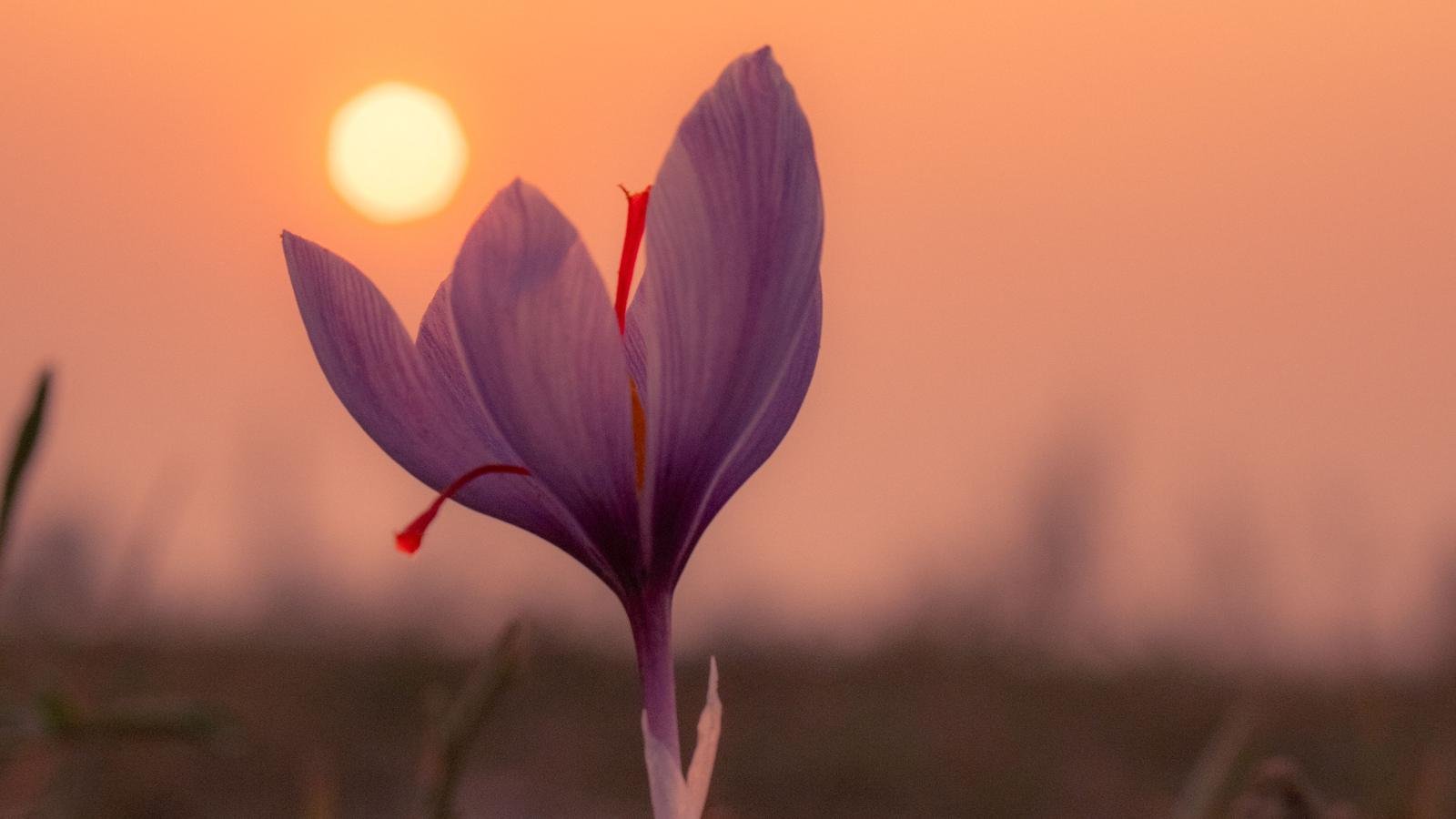
For a few weeks each autumn, the flat farmland around Pampore turns purple. The saffron crocus flowers close to the highway out of Srinagar, families come out at first light to pick it, and for a child it is one of the strangest and nicest things to see in Kashmir: a field of small flowers, each with three bright red threads that turn out to be the most expensive spice in the kitchen.
It is not a full day out. It is a stop. Done well, it takes an hour or so on a cold morning and fits neatly into the drive to Pahalgam. Done badly, it means standing on a busy road at noon looking at bare soil. This post is about the first version.
When the saffron actually flowers
The Directorate of Tourism lists October and November as the blooming season for the Pampore fields. The Kashmir Saffron GI file, filed by the J&K Agriculture Production Department, is more exact: flowering usually starts in the second half of October and carries on into the first week of November, and it depends on temperature and moisture in the soil. A dry autumn can push it back, and a thin year is possible.
So the safe window for a family stop is roughly the last ten days of October and the first week of November. Earlier than that you may see only scattered flowers. Later, the picking is mostly over.
Two things help on the day:
- Ask your driver the evening before whether the fields near Pampore are flowering yet. Drivers who do the Pahalgam road every week usually know.
- Do not judge by the fields right beside the highway. A Government of India tourism story on Pampore notes that open fields by the road, with no shade and the heat of the traffic, tend to bloom later, while the shadier fields in the interior villages flower first. If the roadside looks bare, the lanes behind it may not be.
Why the morning matters
Saffron is picked early. The GI file describes family members harvesting the flowers in the early morning, and by late morning most of the work is done. The flowers are picked at the base and collected in baskets or bags, and the red stigmas are separated out later the same day.
That gives you the plan. Be at the fields in the first couple of hours after sunrise, while the flowers are open and people are still picking. Our own calculation of sunrise and sunset at Pampore for this season:
| Date | Sunrise | Sunset |
|---|---|---|
| 20 October | 6:39 am | 5:50 pm |
| 25 October | 6:43 am | 5:44 pm |
| 30 October | 6:47 am | 5:39 pm |
| 5 November | 6:53 am | 5:33 pm |
| 10 November | 6:57 am | 5:29 pm |
Leaving Srinagar soon after breakfast is usually enough. You do not need to drag sleepy children out in the dark. If you are going on to Pahalgam the same day, the early start also helps with the rest of the drive, which our Srinagar to Pahalgam taxi page puts at about 96 km and around three hours.
Mornings at this time of year are properly cold. IMD's 1991-2020 normals for Srinagar give an October average of about 23.0 C by day and 6.2 C at night, and November about 15.9 C by day and 1.2 C at night. At 7:30 in the morning in an open field, it feels closer to the night figure. Our October weather in Kashmir post has more on the month.
What children will actually see
It helps to tell kids what to look for before you get out of the car, because the plant itself is small and easy to miss.
- The flower. A pale purple crocus, low to the ground, with thin grassy leaves. There is no tall stem. Many fields look like bare brown soil from a distance until you are right next to them.
- The three red threads. Each flower has a three-part red stigma. That is the saffron. The yellow parts are not.
- The picking. Whole families working along the rows with baskets, bent low, moving quickly. This is real farm work on a deadline, not a show for visitors.
- The numbers. It takes well over a lakh of flowers to make one kilo of dried saffron. Children tend to remember that one, and it explains the price better than anything we could say.
If you want a simple game, ask the kids to count how many red threads they can spot without touching a single flower. It keeps hands in pockets, which brings us to the main rule.
Field manners
Every saffron field is somebody's farm, and the season is short. A few rules keep the stop friendly:
- Stay on the edge of the field or the raised strips between plots. The saffron bulbs sit just under the soil, and feet in the rows do real damage.
- Do not pick flowers, even one, unless a farmer offers. A single flower looks like nothing; a hundred visitors each taking one is a loss for the family.
- Ask before you photograph people, especially women and children working in their own family's field. A smile and a gesture at the camera is enough to ask, and a shake of the head is a no.
- Keep it quiet and short. Twenty to thirty minutes at a field is plenty for children, and for the people working there.
- No drones.
If a family invites you to try picking, let one child at a time join in, follow exactly what they show you, and thank them. Some families are used to visitors in season and some are not, and both are fair.
The highway is the real risk
The fields around Pampore sit along the Srinagar to Jammu highway, which carries heavy traffic, including trucks. In season, cars pull over on the shoulder for photos, and that is where the danger is, not in the field.
- Ask the driver to park fully off the road, ideally down a side lane rather than on the highway shoulder.
- Get children out on the field side of the car, never the traffic side.
- Hold small hands while you cross anything, and keep toddlers in arms or a carrier near the road.
- If the only spot is the open shoulder of a busy stretch, drive on and try a lane further in.
This is one more reason to prefer the village lanes over the roadside fields. They are calmer, safer and often have more flowers.
Fitting it into your trip
There are two easy ways to do it.
On the way to Pahalgam. This is the one we suggest for most families. Pampore comes early on the drive, so the saffron fields make a natural first stop while the children are still fresh. Our taxi page suggests families do well with one stop on this road; in season, make it this one. If the morning goes well and the kids are happy in the car, the old temple ruins at Awantipora are further down the same road. The Directorate dates them to the 9th century and King Avantivarman. Treat Awantipora as optional, not as a second must-do. Then carry on to Pahalgam for lunch and an afternoon by the Lidder, or the next day at Betaab Valley with kids.
As a short morning from Srinagar. If Pahalgam is not on your list, Pampore still works as a half-morning outing and back to Srinagar for lunch. It pairs well with a slow afternoon, a nap, and a shikara before sunset. It is a poor fit for a day already loaded with gardens.
Either way, keep the stop to an hour. Children enjoy it far more as a surprise in the middle of a drive than as the main event of a day.
What to pack for a saffron morning
- Warm layers: a jacket, cap and gloves for each child. Mornings can be close to freezing in early November.
- Closed shoes that can get muddy. Field edges are soft, especially after rain or dew.
- Wet wipes and a small towel for hands and shoes before getting back in the car.
- A thermos of something warm and a simple snack. There may be nothing open near the fields that early.
- A phone or camera with a macro mode if you have one. The flowers are small and the best pictures are taken low, at child height.
Our winter packing guide for Kashmir with kids covers layers in more detail if your trip runs into colder weeks.
If the bloom is late or thin
It happens. The flowering follows the weather, and a long dry spell can delay it or make it sparse. If the fields are quiet on your day:
- Ask the driver to try the lanes away from the highway before giving up.
- Look for the low green leaves. Even without flowers, children can see what the plant looks like and where the bulbs sit.
- Do not wait around or double back on a later day just for this. Move on to the rest of the trip. It was always meant to be a stop, not the reason for the journey.
We would rather tell you this now than promise a purple carpet. Nobody can promise one on a given date.
Pampore saffron fields with kids: common questions
Can children pick the flowers?
Only if a farmer invites them to. Otherwise, look and count from the edge of the field. Picking without asking is taking from someone's harvest.
Is it worth stopping in mid-November?
Usually not for flowers. By then most fields have been picked. If your trip is in mid-November, go for the drive and the autumn colour and treat any late flowers as a bonus.
Do we need a guide?
No. A local driver who knows the area is enough, and he can find a quieter field and ask on your behalf if you want to talk to a farming family. Our cab service drivers do this road often.
Is it a good idea with a toddler?
Yes, as a short stop, and with the road rules above taken seriously. Keep a toddler in a carrier near the highway and let them walk only once you are well into a quiet lane.
Can we buy saffron at the fields?
You may be offered saffron near the fields, but we would not make buying the point of the stop. If you want to take saffron home, buy a sealed, labelled pack from a shop you trust rather than loose threads on the roadside.
Planning the saffron stop with D2 Holidays
If you are coming to Kashmir in the last week of October or the first days of November, tell us when you share your dates and we will build the Pampore stop into the Pahalgam drive, with an early enough start and a driver who knows where the flowers are that week. Our Kashmir family package is the usual starting point, our Pahalgam page covers the valley itself, and the distances table helps if you are planning the rest of the route.
For anything else, contact us with your dates, the ages of your children and where you want to go, and we will suggest a plan that fits the season you are actually travelling in.